How early orthodontic care prevents bigger problems later

There is a common assumption among parents that orthodontic treatment is something you wait for — that you hold off until all the permanent teeth have come in, and then you begin. For decades, this was the standard approach. Today, however, the evidence points clearly in a different direction: for many children, waiting is not the most effective strategy, and early intervention during active jaw growth can prevent problems that would otherwise require far more complex, costly, and invasive treatment in adolescence or adulthood.
At Tooth + Tongue – Specialized Dentistry and Anesthesia in Walnut Creek, early orthodontic evaluation is a core part of how we approach pediatric dental care. Our goal is not to over-treat — it is to identify the children who will genuinely benefit from early guidance and to act at the moment when the body is most receptive to change.
What "early orthodontic care" actually means
Early orthodontic care, sometimes called Phase 1 treatment or interceptive orthodontics, refers to treatment that begins while a child still has a mix of baby teeth and permanent teeth — typically between ages 6 and 10.
This is distinct from comprehensive orthodontics, which typically begins once all permanent teeth have erupted. Phase 1 treatment is not about finishing the job. It is about addressing specific structural or developmental concerns at the time when intervention is simplest and most effective.
Not every child needs early treatment. The key is evaluation — identifying which children would benefit from acting now versus those who can wait for comprehensive care later.
What the American Association of Orthodontists recommends
The American Association of Orthodontists recommends that children receive their first orthodontic evaluation by age 7. By this age, enough permanent teeth have erupted — including the first molars and front incisors — to allow an experienced provider to assess jaw development, bite patterns, and emerging concerns.
An evaluation at age 7 does not mean treatment at age 7. For many children, the outcome of an early evaluation is simply monitoring with a plan in place. For others, early action makes a meaningful difference.
Why timing matters in jaw development
The jaw is not static. During childhood and early adolescence, it is actively growing and reshaping in response to forces applied to it — by teeth, by the tongue, by breathing patterns, and by external appliances if treatment is underway.
This responsiveness is precisely what makes early intervention so effective. Applying gentle guidance to a jaw that is still growing requires far less force and produces far more natural results than trying to reshape a jaw that has already completed its development.
The midpalatal suture and its growth window
The upper jaw is made up of two halves joined at the midpalatal suture — a growth plate that runs down the center of the palate. This suture remains open and pliable during childhood, allowing the palate to widen in response to orthopedic forces from a palatal expander or similar appliance.
In early adolescence — typically around ages 14 to 16 — this suture begins to fuse. Once fusion is complete, palatal expansion without surgical assistance becomes dramatically more difficult. Acting during the open window allows the same result to be achieved gently, gradually, and without the need for surgery.
Problems that early orthodontic care can prevent
Severe crowding and the need for extractions
When the jaw is too narrow to accommodate all the permanent teeth, crowding is the result. Left unaddressed, this often leads to a recommendation for tooth extractions — removing permanent, healthy teeth simply to create space for alignment.
Early expansion treatment creates that space by widening the jaw itself. In many cases, this eliminates the need for extractions entirely. The teeth have room to erupt naturally, and subsequent orthodontic treatment — if needed at all — is simpler and shorter.
Crossbite and its long-term consequences
A crossbite — where upper teeth sit inside lower teeth on one or both sides — is one of the clearest indications for early treatment. Left untreated, crossbites can cause asymmetric jaw growth, joint problems, and uneven wear on the teeth.
Correcting a crossbite during the growth phase is straightforward. Correcting it after growth is complete often requires surgery.
Impacted permanent teeth
When teeth do not have adequate space to erupt, they can become impacted — stuck beneath the gum line, growing at the wrong angle, or blocked by adjacent teeth. Early intervention to create space significantly reduces the risk of impaction, particularly for canine teeth, which are among the most commonly impacted in the mouth.
Airway restriction and mouth breathing
A narrow upper jaw reduces the volume of the nasal airway above it. Children with underdeveloped jaws frequently breathe through their mouths — especially during sleep — because their nasal passages are structurally restricted.
Early jaw expansion improves nasal airflow, supports nasal breathing, and can have meaningful benefits for sleep quality, energy levels, and cognitive function. These are outcomes that extend well beyond the scope of traditional orthodontics, which is why at Tooth + Tongue – Specialized Dentistry and Anesthesia we take an airway-focused approach to early pediatric care rather than treating teeth in isolation.
Jaw joint problems
Bite imbalances, crossbites, and functional shifts — where the jaw has to move to one side to close properly — can place uneven stress on the temporomandibular joint. Over years, this uneven loading can contribute to jaw joint dysfunction, clicking, or pain. Correcting these issues early, while growth is still guiding development, protects the joint from this long-term stress.
What early orthodontic evaluation looks like at Tooth + Tongue
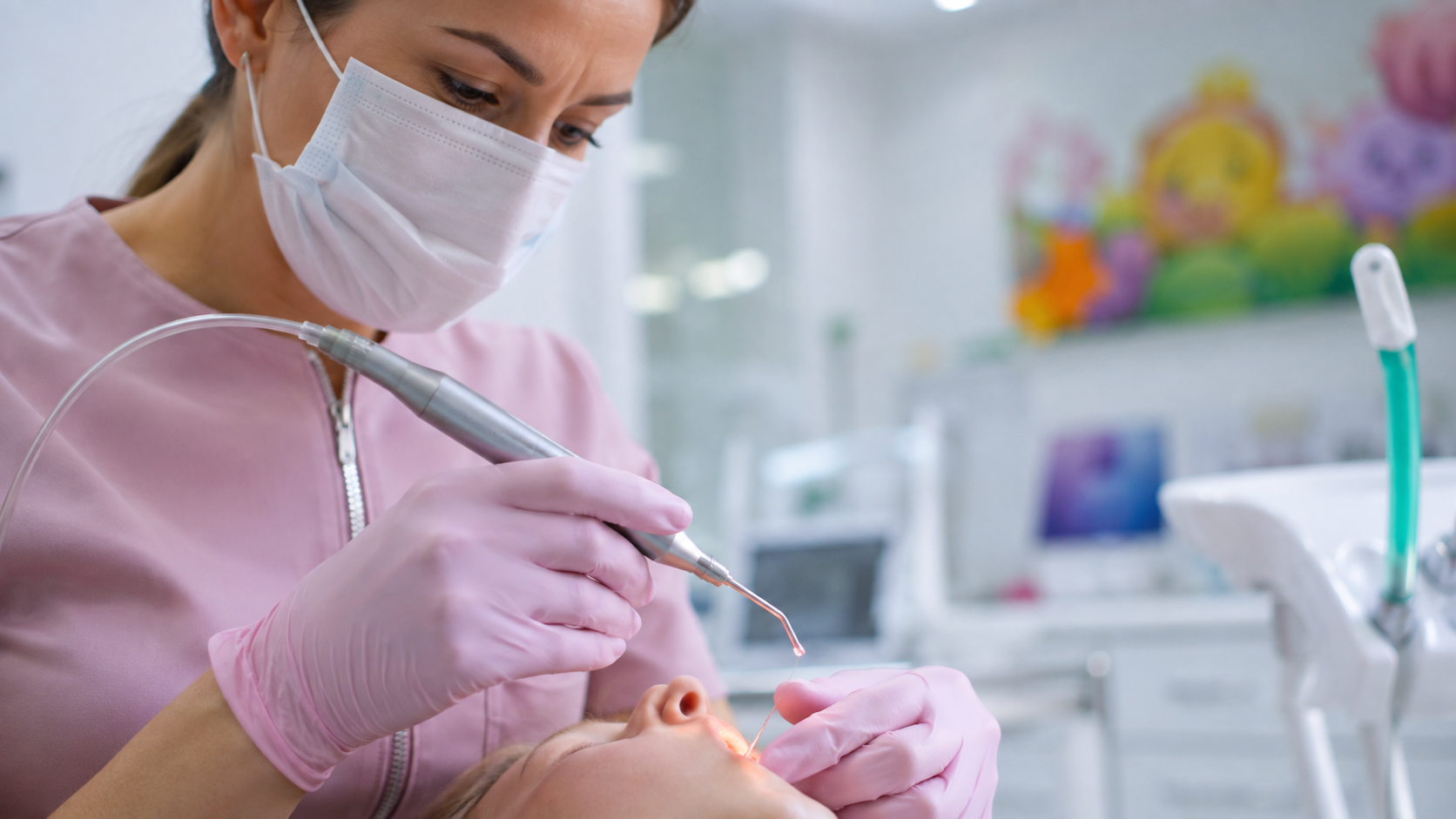
An early orthodontic evaluation at Tooth + Tongue – Specialized Dentistry and Anesthesia in Walnut Creek is comprehensive and unhurried. We assess the relationship between the upper and lower jaws, the position of erupting and unerupted teeth, bite patterns, breathing habits, and signs of airway restriction.
Where indicated, we use CBCT imaging — a low-radiation, three-dimensional scan — to assess airway volume and jaw structure with a level of precision that two-dimensional X-rays cannot provide. This gives us a clear picture of what is happening below the surface and allows for more confident treatment planning.
Tools we use for early intervention
Depending on what the evaluation reveals, early treatment at our Walnut Creek office may involve a palatal expander to widen the upper jaw and improve both dental alignment and nasal airflow. For children with airway and jaw development concerns, the Vivos Airway Growth and Development Program offers a comprehensive guided growth protocol using custom oral appliances worn during sleep and daily wear periods.
For children whose jaw development has been affected by a tongue tie — where restricted tongue posture has limited the natural stimulus for palate widening — we may recommend combining a frenectomy with subsequent expansion to address both the functional restriction and its structural consequences.
Clear aligners for children are also available at Tooth + Tongue – Specialized Dentistry and Anesthesia for cases where early tooth alignment guidance is appropriate alongside jaw development work.
When early treatment is not necessary
It is worth being clear: not every child who comes in for an early evaluation will need early treatment. For many children, the evaluation simply confirms that development is on track, or identifies a concern that should be monitored but does not require immediate action.
In these cases, early evaluation is still valuable — because it means that if something does develop, it will be caught at the moment when intervention is most effective, not after the growth window has closed.
Giving your child's development the advantage of timing
The difference between treating a jaw problem at age 8 and treating it at age 16 is not just a matter of complexity. It is a matter of what is biologically possible. Early in development, the jaw responds to guidance the way a young tree responds to training — naturally, efficiently, and with lasting results. Later, the same correction requires more force, more time, and often surgical support.
Early orthodontic evaluation at Tooth + Tongue – Specialized Dentistry and Anesthesia in Walnut Creek gives your child the advantage of that timing — a clear picture of what is developing, what may need support, and what steps will make the greatest difference while development is still on your side. Explore our pediatric aligners in Walnut Creek for gentle early guidance.
Ready to get started on your family's new dental journey? Contact us here!
Call (925) 949-8427
1800 San Miguel Dr. Walnut Creek, CA 94596
Early treatment connects to pediatric airway dentistry.