Is general anesthesia safe for my child's dental work?
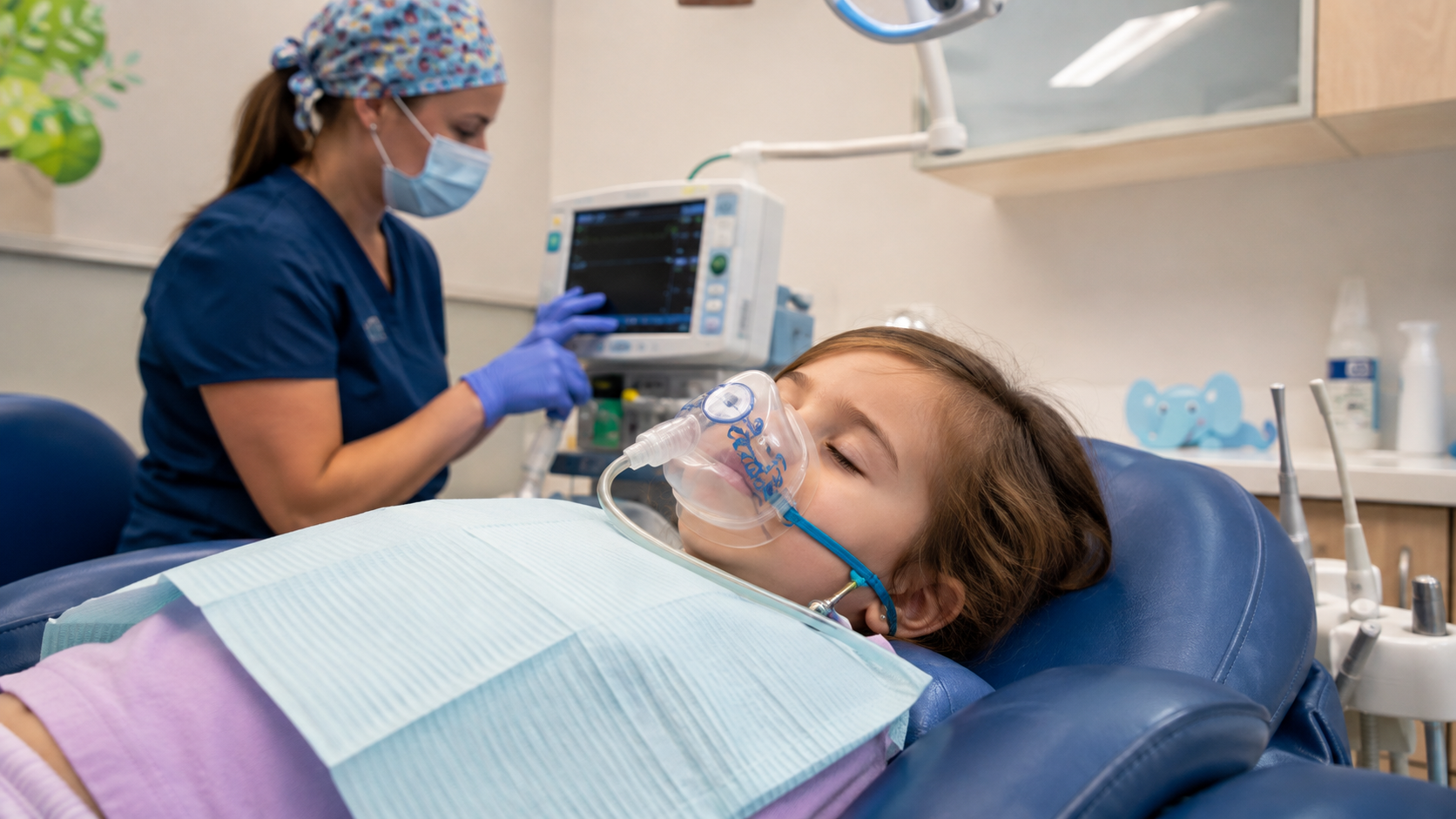
When a pediatric dentist recommends general anesthesia for a child's dental treatment, the reaction from most parents is immediate and understandable: fear. Stories circulate. Questions multiply. And the instinct to find a way — any way — to avoid it can feel overwhelming.
As a dental anesthesiologist who has managed hundreds of pediatric anesthesia cases, I want to address this question directly and honestly. General anesthesia, when administered by a properly trained provider in an appropriately equipped facility, is a safe and in many cases the most humane option available for children who need significant dental treatment. What makes anesthesia unsafe is not the medication itself — it is the absence of the training, monitoring, and protocols that should surround it.
This article explains how we approach anesthesia at Tooth + Tongue – Specialized Dentistry and Anesthesia in Walnut Creek, what safety looks like in practice, and what families can realistically expect before, during, and after their child's procedure.
Why anesthesia is sometimes the safest choice — not the last resort
There is a persistent assumption that general anesthesia represents a failure — that if a child needs it, something has gone wrong with their dental care or their cooperation. This framing is not accurate, and it causes real harm by making parents feel guilty for choosing what is genuinely the right option for their child.
For a two-year-old with eight cavities who cannot understand what is happening or hold still for treatment, attempting to complete that work in multiple awake appointments is not safer than a single well-managed anesthesia case. It is more traumatic, less thorough, and more likely to result in incomplete treatment and ongoing decay.
For a child with autism whose sensory processing makes standard dental care genuinely intolerable, repeated distressing awake visits do not build tolerance over time. They build aversion — and they leave dental problems untreated while the child's relationship with dental care deteriorates further. If your child cries or struggles at dental visits, you are not alone — and it does not mean anesthesia is the only answer. But for the children described above, it is not a last resort. It is a clinical tool that, used appropriately and administered correctly, produces better outcomes in every meaningful way — medically, psychologically, and in terms of the quality of dental treatment that can be completed.
The difference between sedation levels — and why it matters
Not all sedation is the same, and understanding the spectrum helps parents ask better questions.
Nitrous oxide
Nitrous oxide — commonly called laughing gas — is a mild anxiolytic that reduces anxiety and raises the pain threshold without producing unconsciousness. The child remains fully awake and responsive. It wears off within minutes of the mask being removed. It is appropriate for mildly anxious children undergoing straightforward procedures.
Oral sedation
Oral sedation involves a liquid or pill medication given before the appointment. It produces a deeper level of relaxation than nitrous oxide but does not reliably produce unconsciousness. Children under oral sedation are still responsive, though they may be drowsy and have limited memory of the procedure. The depth of sedation is less predictable than IV-administered medications.
IV moderate sedation
Intravenous sedation allows for precise, titratable dosing and a more predictable depth of sedation. Children are deeply relaxed and often have no memory of the procedure, but they maintain their protective airway reflexes. This is appropriate for moderately anxious children or those requiring more extensive treatment.
General anesthesia
Under general anesthesia, the child is fully unconscious and has no awareness of or memory of the procedure. The airway is protected and managed by the anesthesia provider throughout. This is the appropriate level for very young children, children with significant special needs, or those requiring extensive treatment that cannot be safely or humanely completed any other way.
At Tooth + Tongue – Specialized Dentistry and Anesthesia, sedation dentistry in Walnut Creek is offered across this full spectrum, with the level chosen based on the child's age, medical history, dental needs, and the clinical judgment of a fellowship-trained dental anesthesiologist — not a one-size-fits-all protocol. To understand what sets our approach apart from a standard dental office that offers sedation, read our overview of what it means to have a dental anesthesiologist on staff in Walnut Creek.
How safety is ensured at Tooth + Tongue
Pre-operative medical review
Every child scheduled for sedation or general anesthesia at our Walnut Creek office undergoes a thorough pre-operative review. This includes a detailed medical history, review of current medications, assessment of any prior anesthesia experiences, and where indicated, coordination with the child's pediatrician or specialist.
Children with cardiac conditions, respiratory concerns, bleeding disorders, or other medical complexities receive individualized planning. No child proceeds to anesthesia without a clear picture of their medical baseline.
Continuous monitoring throughout the procedure
During every anesthesia case at Tooth + Tongue – Specialized Dentistry and Anesthesia, continuous monitoring includes pulse oximetry, capnography, heart rate, blood pressure, and temperature. These parameters are watched in real time throughout the procedure — not checked at intervals, but monitored continuously.
This is the same monitoring standard applied in a hospital operating room. It is not universal in dental settings, and it is one of the most important distinctions between a rigorously managed anesthesia case and an inadequately supervised one.
Two providers, two roles
At Tooth + Tongue – Specialized Dentistry and Anesthesia, the dental treatment and the anesthesia management are never the responsibility of the same person simultaneously. I manage the anesthesia. The dental work is completed by the treating dentist. This separation of roles is standard in hospital anesthesia practice and essential for patient safety — and it is not the model followed in most dental offices that offer sedation.
Emergency preparedness
Every operatory where anesthesia is administered at our practice is equipped with emergency medications, airway management equipment, and a crash cart. Our team maintains current training in pediatric advanced life support. We do not anticipate emergencies — but we are prepared for them in the same way a hospital operating room is prepared.
Addressing the stories that scare parents
Parents who have done any research on pediatric dental anesthesia have likely encountered reports of serious adverse events. These cases are real, and they deserve honest acknowledgment rather than dismissal.
The vast majority of serious adverse events in dental anesthesia settings share a common thread: inadequate training of the administering provider, inadequate monitoring equipment, inadequate emergency preparedness, or a single provider attempting to manage both the dental procedure and the sedation simultaneously.
These are not failures of anesthesia as a tool. They are failures of the system surrounding it — failures that a fellowship-trained dental anesthesiologist, dedicated solely to managing the child's anesthetic state with hospital-grade monitoring and full emergency preparedness, is specifically trained to prevent.
When parents ask me whether general anesthesia is safe for their child's dental work, my honest answer is: in the right hands, with the right protocols, yes. The question worth asking is not whether to use anesthesia — it is who is administering it and what surrounds them when they do.
How to prepare your child
Fasting guidelines
Children must fast before anesthesia — no food or non-clear liquids for a specified period before the procedure, and no clear liquids after a separate cutoff time. These guidelines will be given explicitly during the pre-operative consultation and must be followed carefully. Fasting reduces the risk of aspiration, which is one of the primary risks of anesthesia and one that proper preparation eliminates.
A comfort item
Young children can bring a familiar comfort item — a stuffed animal, a blanket — into the room with them during induction. This is a small thing that makes a meaningful difference in how a child enters the anesthetic state.
What parents should expect
Induction is typically quick. Children become unconscious within seconds to minutes of beginning the induction process, and parents are not present in the room during the procedure itself. Our team provides regular updates, and a parent or guardian is the first person the child sees in recovery.
Recovery: what to expect after the procedure
Children wake from general anesthesia in a monitored recovery area. Grogginess, mild nausea, and temporary emotional lability — crying or irritability without a clear cause — are all common and resolve within hours. Most children are ready to go home within one to two hours of the procedure concluding.
The day of the procedure should be quiet and low-activity. Children can usually return to normal routines the following day.
Our team provides detailed written post-operative instructions at discharge and is available by phone for any questions or concerns during recovery.
If your child has been recommended for dental treatment under sedation or general anesthesia, or if you have questions about whether anesthesia-level care is appropriate for your child's situation, we welcome a consultation at Tooth + Tongue – Specialized Dentistry and Anesthesia in Walnut Creek.
Written by Dr. Negar Niki Boloorchi, Dental Anesthesiologist and Founder of Tooth + Tongue – Specialized Dentistry and Anesthesia. Dr. Boloorchi completed her anesthesiology residency with a focus on pediatric patients and holds advanced training in airway-focused pediatric care and tongue tie treatment through the Breathe Institute.
Ready to get started on your family's new dental journey? Contact us here!
1800 San Miguel Dr.
Walnut Creek, CA 94596